A recent discussion on facebook about the image to the right (a poster trying to convey a message to prevent rape) has led to me realizing that many issues about rape need to be discussed that simply aren’t. The one discussion led to about two dozen sexual-assault related issues being brought up. Specifically, misunderstandings about who commits rape, racist and sexist stereotypes associated with sexual assault, what constitutes sexual assault, how BDSM is related to sexual assault and even victim blaming and the question of if men can be raped (of course they can).

Interestingly, some of the topics brought up in the discussion were quickly dismissed by other posters. Some oversights made by the creator of the poster were seen as minor problems for various reasons. So, this is the starting post of what I hope will be an ongoing discussion about Sexual assault.

I have much to write about, so I hope that you will be a patient audience. This isn’t an easy topic to navigate and I already know it will be difficult for me and may even be difficult for those who read what I have to say.

In 1879, Mark Twain, unafraid of scandal, said the following;

Homer in the second book of the Iliad says, with fine enthusiasm is worth, “Give me masturbation or give me death!” Caesar, in his commentaries, says, “To the lonely it is company; to the forsaken it is a friend; to the aged and to the impotent it is a benefactor; they that are penniless are yet rich, in that they still have this majestic diversion.” In another place this experienced observer has said, “There are time when I prefer it to sodomy.” Robinson Crusoe says, “I cannot describe what I owe to this gentle art.” Queen Elizabeth said, “It is the bulwark of Virginity.” Cetewayo, the Zulu hero, remarked, “A jerk in the hand is worth two in the bush.” The immortal Franklin has said, “Masturbation is the mother of invention.” He also said, “Masturbation is the best policy.” Michelangelo and all the other old masters–Old Masters, I will remark, is an abbreviation, a contraction–have used similar language. Michelangelo said to Pope Julius II, self-negation is noble, self-culture is beneficial, self-possession is manly, but to the truly grand and inspiring soul they are poor and tame compared to self-abuse.”

Twain’s humor is not ill-placed. Masturbation has been proven to be a healthy behavior.

So, if you’re going to celebrate his birthday …

Note; I obtained this quote from the very first Sexology book I read, several years ago. Sexual Interactions by Elizabeth and Albert Allgeier.

Occasionally, someone will combine a few of my interests for me and they will ask me if I think people have had sex in space, or if I think they will. This conversation often travels down the path of sexual logistics in zero gravity and what needs to be considered in order for sex in space to happen.

Since I have been reading Mary Roach’s book, Packing for Mars, my thoughts on this question had to be modified. Recently, a friend again asked me about what I thought it would take to make “making-it” possible at zero G. So, I thought I should share my thoughts on the matter with the World.

My change in opinion based on Roach’s book wasn’t because of her own commentary on sex in space. Instead, it is based on astronaut training simulations and how they deal with natural bodily excretions. Essentially, basic laws of physics, along with some sort of puritanical standards we set for governmental representatives and national icons, are what stand in the way of extra-terrestrial bone-jumping. Setting the latter problem aside, people have pondered and only minimally given experimental attention to the former.

The thing is, while we have not seen successful copulation at zero G, we have seen several activities involving coordinating movement with two people in space and in parabolic flights and neutral buoyancy experiments and testing.

I used to be an advocate of creating a special sex-in-space suit, like the two suit, designed by Vanna Bonta. This suit tries to account for problems associated with free floating by binding two people together.

I think it may be over compensating, though. Bonta’s suit doesn’t give enough space for imaginative boning. Thanks to traits we inherited from our primate ancestors, we humans are remarkably good at grasping. Grasping, as it turns out, is all we need to keep ourselves from drifting away from our fuck buddy at zero G, just as is done in space to navigate astronauts around each other during cooperative activities. Sex, of course, generally involves much more grasping. In order to prevent acceleration in unpredictable directions, we can use another feature that is already around modern space vehicles, handles and footholds for anchoring.

This leaves us with only one more physical barrier to space fuck ability: sexual byproducts. In space, the junk our bodies produce can cause all kinds of problems. Special procedures are used for bathing and pissing. With sex, the risk of large globs of viscous fluid jamming up important instruments might be greater than the risk of free-floating, gyrating bodies. Condoms are nice, but would be difficult to manipulate in zero G environments. One fumble with the removal of a condom and the individual may accidentally create an experiment on how important control panels are not resistant to the force and contents if a cum-bullet, created by a space-condom catapult. When astronauts have to, containing urine involves connecting oneself to a vacuum and they have to make sure they don’t pee faster than the vacuum can suck. Imagine creating a vacuum device for cum-sucking during intercourse, when just peeing in space is so complicated.

I once saw a video of astronaut Mike Massimino describing how astronauts use the toilet. In the video, he shows a bag for catching zero G shit that has been expelled from astro butts. I imagine that a longer, narrower version of this bag, equipped with a kind of drawstring, may be the key to jizz-containing technology during sexual activity at zero G. I suspect, since it is likely that masturbation has happened in space (and not being aware of other available equipment), these bags may already have gone through a test run, of sorts.

I don’t think sex in space would be as complicated as many seem to think. I think tools for successful intercourse are likely on board the ISS, though, they were meant for other things. This doesn’t mean sex has happened, I doubt it has, but it means it is probably not as difficult as we try to make it out to be.

**UPDATE: Please see the bottom of the post.

So, the new TV dramedia problem seems to be that Chaz Bono, the son of Sonny Bono, who was raised a girl* (Chaz, not Bono), is on Dancing with the Stars. Now, normally, I don’t watch shows like this. I don’t find them entertaining. I rarely watch TV, so when I do decide to watch something, I like it to be useful, somehow. I’m going to make an exception, though. I’m going to try to catch some episodes of Chaz on Dancing with the Stars. Why? Because people are complaining about Chaz. They aren’t complaining about Chaz because he’s bad at dancing, which is supposed to be the point of the show, they’re complaining because Chaz had a sex change.*

This is stupid. The transgender community faces a lot of bigotry which is difficult to deal with, already. What better way is there to create acceptance for something, though, than to keep it in the spotlight? I want to see Chaz succeed, just because these people criticizing him over his sexuality is absurd and stupid and bigoted. (Though, it would be really awesome if Chaz were crazy talented, too).

Because of this bigotry, I want to see Chaz win. Let him rock the world a bit.

So, this is what I want to see happen. EVEN IF YOU HATE THIS KIND OF SHOW, watch it. Suffer through the whole thing. Be sure to watch it in a way that your viewing shows up on the statistics the station gets for the show. View it on satellite or cable. Also, I understand there is voting involved in shows like this. Vote! Make it known that you want to keep Chaz. Yes, you may have to suffer. I’ve heard rumors about shows like this. The mountain lion of inanity may eat your face off, but you must be brave!

Seriously, keep Chaz on the show and help keep the show viewership high. WATCH IT. Also, pass this on.

P. S. If you’re a regular viewer of Dancing with the Stars, keep your non viewing friends updated by posting information about the show and voting on your facebook. I don’t want to encourage cheating (grin), but help raise your friends’ awareness.

*Note: This article isn’t intended to harm anyone’s feelings about the language used when discussing transgender issues. I’m aware of those issues. Sadly, most of this issue is floating around in the media using the same terminology I’m using. Furthermore, it is the terminology people will understand. Raising awareness on this particular thing is more important than being picky over terms that most people aren’t going to understand. I try to write things according to what my readers will be able to absorb as much as possible. Thanks for your understanding.

**There was a bit of a debate over this post. It seems I offended some people in the transgender community. Others in the transgender community seemed to disagree with the ones offended. As a result, I was terribly confused at who was correct. I did know, however, that my post was having an impact I didn’t expect. As a result, I turned to someone I knew could offer some good insight, my friend Tara Birl. She suggested that I change the above post to this to make it more considerate:

—-

So, the new TV dramedia problem seems to be that Chaz Bono, the son of Sonny Bono, who as a transgendered person, identifies male but was assigned female at birth (Chaz, not Bono), is on Dancing with the Stars. Now, normally, I don’t watch shows like this. I don’t find them entertaining. I rarely watch TV, so when I do decide to watch something, I like it to be useful, somehow. I’m going to make an exception, though. I’m going to try to catch some episodes of Chaz on Dancing with the Stars. Why? Because people are complaining about Chaz. They aren’t complaining about Chaz because he’s bad at dancing, which is supposed to be the point of the show, they’re complaining because Chaz finally came out as male.

This is stupid. The transgender community faces a lot of bigotry which is difficult to deal with, already. What better way is there to create acceptance for something, though, than to keep it in the spotlight? I want to see Chaz succeed, just because these people criticizing him over his gender identity is absurd and stupid and bigoted. (Though, it would be really awesome if Chaz were crazy talented, too).

I admit that I fogged up the issue by using the word “sexuality” the way I did, but that has more to do with sexual categorization. I think that Tara’s edits are a good answer to the problem, but by the time I was able to do anything, my post was up long enough that I was uncomfortable editing it so late, but I wanted to acknowledge that improvements could have been made.

Special thanks to Tara for taking an awesome, level-headed approach to this. :)


Don’t forget to vote for Chaz!

Many people seem to think that dressing provocatively, in a way, invites sexual violence against a person and can even cause it. That was the sentiment of a Toronto police officer, Michael Sanguinetti when he said that women could avoid sexual assault by not dressing like sluts. Of course, the response to such a statement was quick and firm.

There is not really any information out to suggest that the way someone dresses has anything to do with if they are sexually assaulted and, certainly, dressing as a “slut” doesn’t excuse someone seriously harming another human being! The view a victim’s clothing might be to blame for their assault is pretty common and often leads to discrimination against victims who are seeking legal assistance, protection and/or some sort of closure. Knowing this, and in protest to the comment made by officer Sanguinetti, Toronto citizens hammered out a demonstration to tell the world that rape, for any reason, is not OK and neither is blaming the victim. Their actions led to many other groups following suit to spread the same message. And so it was that Spokane’s Taylor Malone organized a slutwalk for the city and I was able to be there to see the whole thing.

I had only communicated with Malone over the internet, previously, even though I think we’ve been in the same places before, around the same time (we just didn’t talk). She’s a pretty fascinating person, to say the least, and she made it quite clear that she was dedicated to her cause on facebook. I met her, armed with a small bullhorn, in person before slutwalk was to start at Riverside park in Spokane. The event was a good success, with an estimated 200 participants (though, it did seem like more than that, as people came and went at different times). We gathered together, some dressed for the occasion and some didn’t, to send a message that blaming the victim of a sexual assault was not acceptable. People carried signs and we chanted things like, “Hey, hey, ho, ho, we understand that no means no,” and “I won’t be blamed, I’m not ashamed.”

The message that an individual’s clothing should not invite blame for the harm that someone has done to her was very clear, but it didn’t go without criticism. Here’s a breakdown of some of the criticism that I saw and heard:

Criticism #1: But dressing a certain way is asking for attention!

I don’t really like that I even have to respond to this, but I can’t ignore it, either. One thing, though, that I think really brings out the problem with people thinking like this was rather clear at slutwalk itself. The women dressed as “sluts” wore a variety of clothing. There was a woman dressed head-to-toe in a body stocking with booty shorts and a short top, Taylor Malone was rocking an outfit reminiscent of a 1920s flapper and I was wearing a knee-length skirt, thick tights and a V-neck blouse (which was more modest than most of my normal clothes, actually, but it was cold and rainy – I decided to go with slutty how others had seen it and not slutty as I see things, to stay warm). The variety of “slutty” clothes was pretty tremendous, with many sluts being dressed in clothes more modest than a nun’s habit. Some people chose to highlight the very problem of the subjective term through their clothes, including one woman who dressed as a bellydancer and carried a sign with a drawing of a woman in a muslim hijab. Another woman actually wore a make-shift burqa. My friend and burlesque troupe leader, the Divine Jewels wore something that was talked about in a few conversations that I heard, and a friend of mine told me about it before I even saw it. She wore sweats and a sandwich-board sign. The back of the sign said, “this is what I was wearing when I was raped.” On the back it said, this is what I wear to get respect, and it had a picture of her in one of her tops she made for a burlesque event. It was very clear amongst the crowd that very few people thought of “slutty” in the same way. If slutty can’t be easily defined by a whole mass of people with similar goals in mind, how does one decide what ‘certain way’ is considered to be asking for attention? It seems to me that the problem, here, is that while people may send a message with the clothes they wear, that message may not be shared by an observer and it is the duty of the observer to not force their interpretation onto the individual, especially since the message the observer thinks they’re seeing is very likely not at all correct.

Let me be clear about something, by ‘asking for attention,’ many commenters were literally implying that a person could dress a certain way and be asking for someone to violate them sexually and that if they were violated, it was their fault. I’m not going to say that all people who said that meant that it was OK for a girl to be violated based on her clothing, but many actually implied that. Another related comment was that dressing provocatively was similar to walking through a subway with a wad of 100 dollar bills clearly visible in one’s hand. There are many reasons why that’s bad reasoning, but I’m going to first entertain this concept before discussing why it is a problem. Firstly, let’s assume someone really IS walking through a Subway with clearly visible wads of money in hand. Should that person get robbed, would it be ethical for the police to blame the person for the crime? Of course not! That being said, the assumption in such an example being used is that walking through a Subway with lots of visible money is comparable to walking around in certain clothes where people can see you. Considering how people select others for sex, I would have to say that assumption is probably wrong.

I actually wish we had some sort of study done on this, but, instead, I’m going to have to run with professional experience in my reasoning. I apologize, sincerely, for only having anecdotes to go by, here. Essentially, when someone the victim of sexual violence, various factors come into play. Generally, there is the condition of opportunity, the condition of desire in the criminal which overrides ethical thinking. Basically, a person wants a sexual experience and doesn’t think there will be a consequence for it or doesn’t care. People don’t pick who they’re going to interact with, sexually, based only on signals about availability. In fact, in settings where sex is a product, such as strip clubs and other adult entertainment outlets, more modest girls often make money based on other elements, from them being more modest to their personality being welcoming. In the process of courtship and sexual selection, people frequently find various elements of their potential mate attractive and that’s typically what brings them to desire them.* Because so many factors tend to contribute to sexual desire, the assumption that clothing could be to blame for a significant amount of rapes is, at least, poor logic and, at most, a terrible harmful belief to reinforce (without evidence).

Criticism #2: Slutwalk’s message was unclear. More so than the previous criticism, this one deserves much consideration. What’s the point of a demonstration if people don’t understand what it is about? One person pointed out that a sign that shows up on Google when you do an image search for slutwalk is one that says, “We’re taking slut back.” Assuming that one went to Google images, first, to find out what slutwalk was and then saw the 15th image represented as representative of the message slutwalk intended to send, it could be confusing. Another criticism was about the name “slutwalk.” People got so caught up in condemning the use of the word “slut,” that there was concern that it would overshadow the intention of the whole demonstration. Organizers, though, liked the word because they felt it would draw attention to the issue and as long as the right message was sent alongside it, the event would be productive.

There were opportunities, in the event, to network with other people who share the goal of reducing violence, judgment and helping those who have experienced sexual assault. I got to pass my business card for the Eastern Washington Sex Workers Outreach Project out to people who were curious and I got business cards from people who I know can help those who I try to help all the time.

Based on the conversations I heard and saw at slutwalk, the issues were being discussed amongst the crowd. People took the opportunity to talk about rape prevention. With all the chanting about not blaming a victim and the signs carrying similar sentiment, the only confusing aspect of the slutwalk I attended, I thought, might have been the marijuana petition people, who were confusing to see hanging around amongst the crowd.

The news outlets who covered the event seemed to understand the message very well, and their reports conveyed the desired message exactly as I think was hoped.

More criticisms:

My friend, Linda, was rightfully concerned about who was invited to slutwalk: Slutwalks not for me. Her concern was that because there was going to be an off-duty police officer at Slutwalk and that might make people in the adult industry afraid of attending. People in the adult industry are often real-life examples of the idea that a person should be able to wear or not wear anything and not have to worry about sexual assault. They willingly place themselves in sexually vulnerable positions for pay. Sometimes, their work is illegal (usually for irrational reasons, but that’s a topic for another post). A basic belief permeates society that says that because a sex worker voluntarily puts themselves in sexual positions, they should not be surprised or concerned when they are assaulted. This idea clearly ignores the fact that other people put themselves in compromising positions for their work, too, but we don’t reinforce injustices against them because of it. If a journeyman loses an arm to a giant mechanical device, we don’t say, “well, that’s what you get for working around giant machines!” There’s a reason for that, it is senseless. It is as senseless as it is for people to dismiss the the issues faced by sex workers because they choose work which makes them sexually vulnerable.  They are often devalued when they have been assaulted and are not only mistreated as victims, they are frequently ignored. Sex workers are a group that really needs to be represented at events like Slutwalk and they need to be visible. That being said, sex workers also don’t need special treatment. A sex worker could have been equally affected by someone participating in Slutwalk or someone not participating. This is why many women who were invited by me turned the opportunity down. They didn’t want to be outed as whatever type of sex worker they are, so, as far as I know, I was the only one representing Sex Workers at Slutwalk Spokane.

There have been many other types of criticism aimed at Slutwalk that have come out over the last week. I haven’t been able to keep up. If you have something specific you’d like me to address, please let me know in the comments section and I will do my best to respond to it.

Overall, I think Slutwalk was successful in its goals. Movements like this are meant to draw attention to an issue and the media coverage does seem to have made that happen. Of course, some people are going to get the message wrong. That kind of thing happens with many issues. The best way to deal with that is offer the correct information where you can and then continue.


*I know, it is precarious to discuss desire as a motivator for sexual assault. I am not a promoter of the notion that sex crimes are always about control because I think we have enough evidence to show that’s not true. Sometimes, they are about control and sometimes they are, sadly, about sexual desire. We can save the controversy about that for another post, though.

It’s true, I did it. I’m guilty of all of these crimes.

By making this woman feel threatened and afraid for her life, I am guilty of assault and battery. By entering the premises without permission, I have committed burglary. By causing a general disruption that significantly impacts someone’s life as well as the lives of their loved ones and which has led to this day in court, I am guilty of disorderly conduct. By inflicting harm on this woman, by nature of my presence, I am guilty of domestic violence. By insisting that my presence be made known, by not going away when asked and by interfering with the safety of this woman, I am guilty of harassment. Once the camera is on me, and as I am sitting here naked, I will soon be guilty of indecent exposure. By the time this is all over, since my presence will have disturbed the general perception that everyone has of this case, I will also be guilty of contempt of court. -Fetus Pro Se

If I say that this quote is allegedly the statement of a fetus, you’d probably call me out as saying something absurd, right? At least, I would hope that you would. It is absurd. The idea that a fetus could ever have the capacity to understand and utter such things is absolute nonsense. Fetuses don’t know anything!

But while the italicized comments are absurd, that doesn’t mean that a fetus can’t be used in a court case. In Ohio’s battle over abortion rights, that’s precisely what they want to do.

When the news that a fetus would be present in court, the Internet, of course, responded with mockery. Were it the case that the fetus were to articulate some sort of testimony in its defense, I’m sure that mockery would have been justified. That isn’t what is happening here, though. Instead, the fetus pro se is actually not pro se (as in, it isn’t testifying on behalf of itself). The fetus is there so that it may be displayed in court as having a heartbeat.

Of course, this move seems clever on the part of the pro-life crowd, but just because something is a clever stunt does not mean we can just dismiss it as invalid. Since the question on this case is if a fetal heartbeat is enough to grant a fetus rights. It does make some sense, then, to demonstrate something to the court as to why that would be. Enter: Fetus.

Court cases serve an important function, for us, and while this case is offensive and horrible because it is a proposal to steal away our rights, we still have to let the judicial process happen and that means that if the other side makes their case by putting a pregnant woman on display, than so be it. Let the fetus trial begin!

It isn’t as if there aren’t many, many ways to argue against such a display. If you want to follow the same route as theirs, someone could certainly produce evidence of parasites which pulse and move in the human body. It would be easy to point out that, while a fetus has a heartbeat early on, that doesn’t mean that the fetus isn’t somehow causing harm by existing where it may be unwanted. Regardless of if some pro-life group is doing this in seriousness or is trying to slip in some complicated emotional appeal in their case, we have to let it happen and ridiculing it and pretending it is something that it is not (a fetus taking the stand) is only entertaining the desire by pro-lifers to assign a personal connotation to the fetus, instead of approaching the matter with some level of maturity and logic. If we have a case in court about heartbeats, let them present a heartbeat.

Oh, and get off my lawn.

I am not a scientist. I also do not have testicles. However, if I had testicles, I would give my left testicle to be a scientist. I haven’t given up on science, though. I am a die-hard science nerd. I also happen to be very happy to be the owner of a nice, shiny, highly functional vagina. I am a girl in a world that many still see as a man’s world. It has been a long and difficult journey, for women, to become able to exercise their rights the way men have for centuries. Our gender worked hard to get here, and there is still, very clearly, more work to be done to obtain equality. At the Science Online 2011 conference, one of the topics of discussion was in regards to women in the science blogging community. Scicurious and Miriam had some things to say about it. Since I think it is important to discuss these things, I felt the need to respond.

I’m going to respond as I go through their post. I respect both women (scicurious is one of my favorite people on twitter) and trust that people will take each position on its own merit.

Miriam: So here’s what I’ve been thinking during this very very earnest discussion on women science bloggers. We have a fundamental conflict between selling science & including women. Everything in our society is sold with female bodies. Just check out the blog Sociological Images. Everything from household items to soap to apples. Everything.

While I think discussion about women science bloggers and how to sell them is an important topic of conversation, I also think it is important to note that I don’t think everything is sold with female bodies. At least, not in a sexual way. 50% of the population happens to be women, so it would be difficult to find a product that doesn’t have advertising that includes a woman, somehow. But, sexual imagery with a woman is not something that is always seen in advertising. It is there often, but not everything is sold that way. Some examples:

  • Hemorrhoid Cream
  • Hungry, Hungry Hippo (the children’s game)
  • Tongue Depressors
  • Krylon Indoor/Outdoor spray paint

Even if it were the case that everything was sold using sexualized images of women, that seems pretty irrelevant if we’re really trying to question if it is appropriate to do so. As we know from history, just because everybody does it doesn’t mean it is a good or bad trend to follow.

Miriam: So tapping into this to sell science is very effective. It totally works. Scicurious: But it utilizes a framework that involves the objectification of women’s bodies to the detriment of women, who continue to be objectified and thus get judged not on what they do, but on how they look. What a man says on blogs is usually (not always) disconnected from his looks, while a female face on a blog tends to be associated with whatever she writes, and the quality of what she writes is influenced by the way that she looks.

It doesn’t necessarily work, actually. It can work, sometimes, but as I’ve mentioned in the past, context is important. Sex is only a good advertising strategy if the advertisement is in the right context. Otherwise, it is ineffective. Also, as a person who has to strike a balance between being a sexual image and contributing intelligently to the world around her, I don’t really think that how a woman looks really has to play a huge role in how people value her as a writer and academian. While many of my readers may find me attractive, I’ve yet to encounter a single person saying something sexually inappropriate in reaction to anything I’ve posted on shethought. In fact, I suspect that most of those readers don’t even know what I look like, or what many of my peers on there look like. I agree that having a vagina does affect how a blog is received by readers.  In fact, I think what I wrote in 2009 , when Sheril Kirshenbaum had to deal with the problem, is still very relevant, today. Owning a vagina and being a writer means that we sometimes have to deal with some tactless hounds. I don’t think that problem is necessarily something that should be a deciding factor on if something or someone in the scientific community uses a sexual theme to market themselves. Marketing something a certain way does not mean that the marketing theme has to be something that the product always conforms to. Just because fruit of the loom, for example, used commercials with men dressed up as apples and grapes does not mean that men who wear underwear must then dress up as apples and grapes. Likewise, if the Science Cheerleader uses  cheer leading as a theme in how she advertises science, that does not mean that everyone in the science community must suddenly be a cheerleader, nor does it mean that is what the world will expect.

Scicurious: Well, how many women WANT to come forward and say “You were called hot, I was called fat and ugly”? There’s another little issue in there, I think. The fact that, when you get complimented, it is somehow more OK than if you get harassed for being ugly. People seem to feel more sympathy for those who are harassed for being pretty.

I actually think this needs more attention, but, as stated, nobody wants to highlight that they’ve been called ugly. Well, except me. I’ve complained about that behavior, before. You know what happens when you come out to a wide audience and say, “hey, so and so says I’m ugly?” Well, you find all the people who think you’re not ugly. I don’t think the problem is that people stop feeling sorry for those who are made fun of because someone thinks they’re ugly, I think the people who receive that kind of criticism either don’t mention it (because they don’t want to repeat something like that) or, they mention it and are quickly told that the person who harassed them is a loser and wrong. There’s an interesting side problem to this, though. For those who are told that they are ugly, I’ve noticed that it is sometimes difficult for their readers or peers to correct that problem because it is also considered inappropriate for a reader to say that they are attractive. As a result, there’s this odd hazy area when it comes to appropriate behavior. So, as a side question, is it appropriate for people to tell someone they’re attractive if you’re trying to help them recover from someone else’s bad behavior?

Miriam: And some women – who perhaps are a little younger – do think it’s a compliment. At first. But I think the true nature of those type of compliments becomes clear – and it comes back to using the female body to sell everything.

I think that the problem isn’t that one person thinks something is a compliment and another does not. Instead, I think that this is a problem because of context. Much like the aforementioned issue with Sheril, and the problem I wrote about on shethought, here. There are times when a compliment is appropriate and there are times when it is not. Also, there is a problem when it comes to who will welcome a compliment and who will not. If someone compliments me, I often welcome it, but it depends on the context, as well. I’m going to quote myself, here, because I think it is relevant:

This is a whole other issue, entirely. Sometimes, I care what people think about my appearance, sometimes I don’t. I like a variety of compliments and that includes compliments about my appearance, about my intelligence, about my skills. Would it still have been a problem if this person complimented her on something else? What if he complimented a book she was holding, a sticker on her car or her taste in coffee? Would that still be offensive? When we get a compliment that we don’t want, why don’t we treat it like we do input about other things that we don’t want? You know, like when you go through the checkout at the store and the clerk mentions that they’re raising money for the elite baby vampire robot olympics and would you like to donate? Unless we have a special interest in elite baby vampire robots, we’re likely to just pass that one over and the incident is forgotten as quickly as it happened. The clerk is free to mention it and we are free to dismiss it. It doesn’t matter if the clerk thinks that we care about it. This is one of those situations where it is our own reaction that matters, not that someone else did something. As long as they haven’t harmed us, they’re not responsible for how we take it.

While context for a compliment is important to consider, sometimes even moments where the context might be appropriate, we still don’t want to hear that compliment. That’s where the above paragraphs come from. So, while I may end up in a situation where there’s a compliment that I like and I accept it, if another person is in the same situation and they don’t like it, that doesn’t mean that the person issuing the compliment is somehow malicious or villainous or that the person who lacks desire for the compliment should necessarily be offended. Instead, dismissing the compliment as they would a comment on their shoes, that they don’t care about, is probably the best plan of action.

Miriam: Those of us who are trying to sell our brains are NOT selling our looks, and it’s insulting to presume that we are. Scicurious: Then when you get a compliment on your looks in the workplace, it’s like a slap in the face, taking away the other things you strive so hard to be proud of, by telling you what really SHOULD matter: your looks. Many people may say that really when you get a compliment on your looks, what they are REALLY saying is that you can be pretty AND do science! But why should the pretty even MATTER for your content? Why should this be pointed out at all? It has no effect on the content you are presenting, and mention of it is thus at least a non sequiter. But what it really does is remind you that you can be brilliant or not brilliant, or do good writing or not…but you’re so PRETTY!

At least, when there’s not any indication that you’re selling your looks. If you were someone who wanted to be a sexual image and wanted to write about science, I think that should be your right as much as it should be your right to write about science and not be sexual. When it comes to science and sexuality, I sell both. In fact, I enjoy selling both. I think that the thing that really bugs me about this debate is that there are so many valid points on all sides, but it has become a kind of ingroup/outgroup thing. I would love to see women in the community who don’t want to be sexual to be regarded in the light that they want to be seen in, but I don’t want them to have that at the expense of people like the Science Cheerleader or myself. I think that it is a false dichotomy to think we have to have either a sexualized element in scientific promotion or that we can’t have it at all. I want to be myself and to continue discussing science and feminist issues with my peers and I want my peers to remain as they wish to. I be me and you be you – I think that’s extremely important. For most women in the scientific community, I agree that it makes little sense for someone to follow important, informative posts with “gawrsh, ur hot!” when it doesn’t fit the context. I don’t think that should be a reason to strip all sexual elements from other people’s contribution to the community.

Scicurious: I feel like using hotness or women or sexy to sell science is not good for the women IN science. But i also think it’s not spectacular for science itself. Miriam: How so? Scicurious: Coolness doesn’t rub off. Putting science next to something that’s cool doesn’t make it more cool. It makes it science, standing next to something cool, and I feel that science has a great deal to sell itself on its own merits.

Doesn’t that mean that science will stand, regardless of context? If this is true, then it shouldn’t matter if I promote science while dressed in my petticoat, corset and kitten-kicker boots or if I’m dressed in coveralls, the message is the same.

Scicurious: To sell science with sex implies that it’s not GOOD ENOUGH on its own, that science itself can’t be fascinating or interesting unless it’s got glitter on it. But it CAN be! Look at the citizen science projects! They makes science perfectly interesting and fun, without having to prop it up next to something that’s sexy.

I don’t think that promoting science with a sexual image means that science is uncool on its own. That’s kind of like saying that men’s underwear would be unpopular, on their own, if we didn’t have visions of human-sized grapes and apples dancing in our heads. The imagery might be used to get attention to an idea, but that doesn’t mean that the product, itself, has nothing to offer on its own.

Scicurious: Yeah, I have to say that sounds really cool…but that’s not using women to sell it, it’s using something else, and something which has not yet been deemed to be harmful.

What evidence is there that it is harmful to women to be advertisers? If it *is* harmful for women to be advertisers, why is it not also harmful for men to be advertisers? or babies? or puppies? I’m not convinced that selling something with a woman’s image is harmful to women, in general. I’m not convinced that science would be ‘better’ than the rest of the world if they avoid sexual imagery when promoting itself. I don’t think that using or not using sexual imagery makes something better or worse than the next thing. In fact, I suspect that attitude has become an excuse for marginalizing a segment of the population. I admit that there is some bias, on my end, since I’m the population being marginalized and directly affected by that attitude. I am the outgroup that is shunned when others decide that sexual imagery is somehow a ‘bad thing’ and should always be avoided in certain situations. The thing about being in the outgroup for something like this is, it sucks.

Miriam: Exactly. And then we come back around again to selling science with sexy women. People made arguments that Nerd Girls or cheerleading are not actually about sexy women, which frankly I think are ridiculous.

When I write on shethought or indieskeptics, it is not about sexy women. Most of the time, when I write here on sexandscience, it is not about sexy women. Instead, I write about things like issues surrounding abuse, mummies, health, the Muslim use of the veil, and abortion. Me being a sex worker doesn’t play a role in those articles. They have nothing to do with sexy women and the people who read them aren’t thinking about sex, usually, when they read them.

Scicurious: Also…why science cheerleaders? Why not literature cheerleaders? Financial cheerleaders? English teachers surely need more exposure and appreciation.

Is cheerleader reading advocates close enough? Why would the existence or non existence of other types of cheerleaders be relevant to if a science cheerleader should or should not exist?

Miriam: I’m rather fond of the Radical Cheerleaders. They cheer for left-wing causes, are kinda punk, and include a range of body types.

Actually, this comment touches on the real problem more than anything else that has been said. Stereotyping. Isn’t the real problem more about how scientists tend to be non-conformists and by tossing in a sexual theme with a stereotyped womanly image, we feel a tiny bit of loss because now we’re being shoved in an uncomfortable direction, into the mainstream? Why is it acceptable to have a sexualized image of people who have a range of body types but not so acceptable if the image is of someone who conforms to a beauty stereotype? Is it better that I’m a fat, perhaps a little gothy, chick than it would be if I were a skinny cheerleader? Should that make a difference at all? Why? If we do think it is suddenly acceptable to have a cheerleader, perhaps sexy, image if the imagery is of women with a range of body types, aren’t we then contributing to the problem of ingroup/outgroup behavior by placing the Science Cheerleader in the outgroup to our ingroup?

Scicurious: Too true! I usually try to start out my days pretty well dressed. it makes me feel more confident, but at the end of the day, I smell like rodents. Oh well, at least Sci-cat thinks its pretty cool. And of course no one wants to punish people for being good looking. You’re ALLOWED to be good looking and a scientist.

Yay! Now I need to get the scientist part down.

Scicurious: Darlene Cavalier has stated in comments on my blog that she wants it to be ok to be good looking, and a cheerleader, and a scientist. I think that’s great and just fine, but I worry that using cheerleaders to promote science makes the looks supersede the science. And while using cheerleaders, and things that little girls like, to promote science for kids SHOULD be fine, it’s only really fine when we live in a society where we do not have to worry about being taken less seriously because of our looks. Sadly, we do not live in that society, and cheerleaders have far more connotations than just being role models for little girls.

I don’t think that context makes it wrong or only OK when we have a different society. Isn’t that kind of like saying that it is only OK to eat blueberries in a certain context or it is only OK to dress a certain way when society is different? I don’t think the ethics surrounding this issue change just because we don’t yet have the society we want. Also, if society is really the problem, then shouldn’t we work toward changing that problem instead of changing this behavior just because that problem exists? In fact, I think that because there is a problem with people’s personal biases, that’s all the more reason to show people how we can break the norm through being whoever we are HOT or NOT, and still being smart and educated. If you want people to take you seriously as a hot scientist, then be a hot scientist and let people see your value that way. If you want people to take you seriously as a non-hot scientist, then be that. It is entirely up to you. Don’t hide from what you are because you’re concerned that society hasn’t matured as much as you. If we always did that, then we’d NEVER see progress. We’d forever be stuck in this cave where scientists can’t be hot or scientists can’t be women and ugly in order to be heard. That would be really unpleasant!

Scicurious: I think there is a divide here. People want to promote science, and the easy way to do that is based on using female images to make science sexy. But I’m not sure we can do that AND try to keep comments on our boobs away from our blogs at the same time. While, in a perfect world, we SHOULD be able to do this, there’s no perfect world, and there are still too many connotations with using sexy to sell science that could negatively affect the women trying to perform and write about science on a daily basis.

I think there’s got to be a way to promote science that is effective and exciting. Citizen Science projects and fun science blogs for kids and adults are a GREAT start. Other great ideas for outreach are things like math books for girls and books on math and science that spark general interest, and are BY women, but do not focus on appearance. I think we can and should build on that kind of outreach. It’s great to look however you want, and do whatever you want (cheerleading, gymnastics, D&D, anime), and still do science. But mostly, it’s great to DO SCIENCE!

I think we should have the best of both worlds, really. There should be science outreach that is non-sexual, but I also think that the science blogging community should embrace the diversity that exists and welcome those who promote science in their own ways, no matter if it is a sexy promotion or not. I think diversity is important and that dismissing sexual imagery in association with science is only helping to create rifts within the community between a minority who doesn’t mind being sexualized or who are excited about presenting their subject matter as a cheerleader.

Oh, and I completely agree with that last part, YAY, SCIENCE! Now I have to find a left testicle for it.

A couple weeks ago, a friend of mine directed me towards a reality TV series called “Hookers: Saved on the Strip.” The show revolves around someone I have heard of before: Annie Lobert. Annie runs an organization called “Hookers for Jesus” and a place called “Destiny House” where she brings hookers to Jesus and pretends that they’ve all escaped from slavery. If you go to her website, you’ll find that ‘about page’ starts out with this:

Hookers for Jesus is faith based organization that addresses the realitiesannie-lobert of human sex trafficking, sexual violence and exploitation linked to pornography and the sex industry. We are committed to reaching out to children/teens/women that need assistance/escape from sex slavery.

One problem with Hookers for Jesus and the shelter she runs, Destiny House, is that Lobert uses misleading information and ideas in order to promote her organization. Based on her website, you’ll find that she seems to assume that women in the industry are somehow slaves. Obviously, anything people think is really bad should be compared to slavery or internment camps, right? The Facts page at the Destiny House website also promotes a lot of things that aren’t even true.

12-14 – Average age of first involvement in prostitution.

I’ve debunked this before. So I’ll just quote myself to save time:

That’s a lie that has been repeated for a long time, all over the place. Someone did a study on children who were forced into prostitution and then assumed that the numbers in the study on children applied to the industry as a whole. Obviously, that’s really bad reporting. It is really bad science and it is a horribly damaging myth to spread. It is sad that it is such a widespread myth. It is one of those myths that people believe because it is scary, not because there’s a rational reason to believe in it. A quick meta analysis of the information gained from this study on women detained for prostitution, you know, an actual study that collected data on the actual group we’re talking about, the average age the participants started prostituting themselves appears to be 20. Of course, we need far more information and this study has a natural bias because the people conducting the study were after other information. However, applying that data to the question of what the average age people enter prostitution is would certainly be far more accurate than using a study that was only about children entering prostitution.

Other aspects of Lobert’s site are misleading as well. For one thing, she focuses a lot on ‘facts’ related to child sex trafficking. However, there is no evidence, anywhere that I have seen thus far, that Lobert interacts with children who have been sex trafficked. In fact, where most of the ‘facts’ are related to children, on the Destiny House website, it seems unlikely that Lobert deals with children very much at all. Because when a child is found in the sex trade, it is usually a case of child sex slavery and the case gets turned over to Child Protective Services. Unless Lobert has some sort of license that allows her to foster such a child, and a suitable location for the child (which the Destiny House does not appear to be), then she can’t do the things for those children that she lists as her services on her organization websites. In other words, Annie Lobert is lying.

Furthermore, the issues facing children forced into the sex industry are dramatically different than those facing adults in the sex industry. So making a big deal out of children she’s not helping doesn’t tell anyone much at all about what she does for the women she’s supposedly helping and spouting off information that is completely unrelated to the women in her shelter is, at best, not helpful and, at worst, deceptive. I don’t think I can stress this, enough; children are incapable of giving informed consent like these women were. Children who are forced into this industry face much bigger problems than adults in the industry. They’re more vulnerable and more prone to long-term problems because of their own situations. Lumping them together with the women is demeaning to the experiences of each group.

So, I watched the first episode of Hookers, because I felt I really needed to know what was being said about the sex industry, if anything at all. Annie kicks off the show with this little gem:

Each year, more than 100,000 women and children are sex trafficked in America. They’re bought, sold, beaten, raped and killed every day. No one hears their cries for help. For over a decade, I was one of them. I sold my body and I almost lost my soul. My name is Annie Lobert, and I’m the founder of Hookers for Jesus. The Las Vegas strip is my office and my job is to get women off the streets.

Does that statistic sound suspicious? It did to me. So, I turned to Google. On google, I found no study that stated anything like this. Yes, people are sex trafficked in America. There are such things as people being forced into slavery where they are expected to do sexual things. That is a very, very serious matter, but as far as I have seen, thus far, Annie isn’t working with sex slaves and she pretty much pulled that statistic out of her ass. Also, based on the implied definition she uses on her website of ‘sex trafficking,’ that should be a bigger number. If sex worker is the same as sex trafficked, as she implies, then she’s got a lot more counting to do if she’s to find out how many there are. The sex industry is a very large industry. It is also ethically icky to imply that you’re saving sex slaves when you’re actually helping people who voluntarily entered an industry. Shame on you, Annie Lobert!

Also, while the instance of domestic violence is higher per capita for people in the sex industry, implying that all in the sex industry experience this is misleading and saying that the solution to the problem is getting them out is kind of like saying the solution to people drowning is no longer allowing anyone to play in the water. People will, very likely, always like to play in the water and people will always be inclined to do sex work. The solution to the problem of violence against people in the sex industry is to make the sex industry safer, just like the way to prevent drowning is to teach people to swim and navigate water.

I want to reinforce something about this show, really quick, because I think it is important. Nobody featured in the first episode of Hookers: Saved on the strip was forced into the sex trade. All who are featured, including Annie, herself, describe their situations and it is clear that their entry into sex work is a choice that they made. Slaves don’t get to choose. It is evil to take advantage of real slavery and child exploitation in order to benefit Hookers For Jesus and to claim that people who were free to do something were slaves or related to those two horrific experiences. Annie Lobert was never a slave. It is sickening that she attempts to imply that she and, others who have made choices in their lives, that they decided they didn’t like, are slaves.

All that being said, I’m not against an organization that helps women leave the sex industry, if they want to. I am against treating the sex industry as if it is a ‘bad thing,’ itself and I’m against this organization using religion in order to accomplish its goals. What happens when someone wants to leave the sex trade because they just want a change and they have some other religious affiliation? Adding guilt and a natural bias against them for their choices and their lack of being a jesusphile is not going to be useful to them at all.

The first episode of Hookers focuses, partly, on a girl named Regina. Regina has a few good points to make in the show, even though they try to make her story side with Lobert’s point of view. For one, Regina has stripped before and says, multiple times, that she doesn’t think stripping is the same as selling sex. She’s right! Lobert seems to assume that, because she met her pimp while she was stripping, that selling sex and stripping go hand in hand. She actually claims that stripping is a gateway to prostitution. This is misleading. Some strippers might sell sex, but many do not. In fact, some of the highest paid strippers that I know of don’t sell sex because if you sell sex, then the guy cums and he goes home and stops paying you. Selling sex, for strippers, is bad for business. Most strippers are also aware of the dangers of selling sex and so they object to it based on a variety of other reasons, such as they don’t want to go to jail or they don’t want a disease or they’re loyal to their spouse or boyfriend. In fact, other than the potential to go to jail and not wanting to lose money, the reasons for not selling sex for strippers pretty much mirrors why most other people might not have sex with a random person. Strippers, as it turns out, are quite capable of making appropriate sexual decisions for themselves.

bio_page_regina_400An interesting element of this episode is that Regina and Annie share the screen time devoted to telling Regina’s story. I’m not sure entirely why, because there doesn’t seem to be a problem with Regina telling her own story. To further make this element of the show odd, to say the least, the story told by Regina about herself and the story told by Annie about Regina don’t seem to be entirely congruent. Annie assumes that Regina was kicked out of her home situation and, while Regina doesn’t completely contradict that, the way the story is cut up for film, Regina makes comments about calling her dad to tell him she entered the Navy and it doesn’t seem to flow with the story about a kid being kicked out. I could be wrong about this, but the story seems to be broken, here, at a critical point in the story. Regina met her pimp in the Navy, but saying she was kicked out of her house makes her story more dramatic, I guess.

Another element of Regina’s story that is worth considering are her comments about money.

The last paycheck I got, I could have made that in an hour.

That comment leads to another scene where Lobert says, “The money is definitely what keeps girls in the business.”

That’s only partly true. Money is a great motivator, I have no doubt about that, and Regina is wise to miss that money. Money gets you food and shelter and Internet access and Darth Tater, the Mr. Potatohead version of Darth Vader. Money is a nice thing to have and when it comes to making decisions based on if you have spare cash for a spudly Sith Lord or you can barely afford Ramen Noodles, many people will opt for the option to fork out the dough for Master Tater. That being said, there are other reasons why the adult industry is an appealing place to be. For example, a job based on pleasure is a hell of a lot better than a job based on removing grease from a fast food service grill. Also, being able to have control over your schedule, not having an actual boss to report to and having the freedom to say and do things that you want to and get paid for it, is a really awesome work situation to have.

I will soon watch the second episode of Hookers, and if I deem it necessary, I may write a response to it, as well. For now, I’d like to see Annie’s take on her spreading misleading information around and offering such biased services through her organization.

Note: It was really difficult to not make fun of Annie for mistaking the Squirrel’s penis for an umbilical cord. And the one thing that made the whole show worth watching was hearing the lady at the stable say, “we’re going to learn some things with these horses and shre what they have to offer. The outside of a horse is what’s good for the inside of a woman!” Hilarious!

When I was 23, I worked for a school district in my hometown as a Teacher’s Assistant. I was pretty good at my job. My sister, who was 16, at the time, attended the same school district.  I frequently took care of her. She was a troubled kid, which isn’t surprising, since over the previous 10 years, she had partly been raised by me. It was always easy for the school district to contact me when she caused problems in school, since they always knew where I was. One day, I was called to the Principal’s office at a grade school I was working at. They were informing me that, yet again, my sister needed me. My default thoughts were that she had stolen something, skipped school or yelled at a teacher. That’s why they usually called, anyway. I was wrong.

I rode my bike across town, a three mile ride, in a very short time, to get to my sister’s High School. She was sitting in the nurse’s office, arguing with the school’s Vice Principal. Her yells were full of emotion, she was sobbing and clutching her hand to her chest. “You’re not going to tell my parents!” Most of the time, she didn’t care what our parents heard about what she did. They were usually unable to do anything about it. Dad worked too much and mother was so ill by then that she barely did anything beyond self-care and, even then, she needed help for her dialysis. I had more control over my sister’s behavior than they did. So why did it matter if Mom and Dad knew that she’d been in another fight and why wasn’t she protesting them calling me? She hated when I showed up at her school for disciplinary problems. She viewed me as something of a parental figure and so she rebelled against me, too.

As it turns out, she wasn’t just in a fight, she’d been trapped and beaten up because someone saw her staring at another girl. My sister has always been bisexual, she’s known since puberty. Her sex life started when she was 14 and most of her partners were girls. I was aware of it from the beginning. She was terrified of our parents knowing. Their Mormon dogma condemned such things and she didn’t want to be seen as an abomination. Furthermore, my parents already pinned every other problem she had on sexual abuse, she didn’t need innate parts of herself blamed on the same thing. Thus, her sexuality was a secret that I helped her keep. That’s why, when I showed up at her school, she fell into my arms, sobbing, and asking me to tell them not to tell dad.

My role that day was to save her from something. Something that I had to protect her from for years. That moment, holding her in my arms and trying to calm her, helped define how I approached the world’s views on human sexuality. Over time, I became more and more aware of sexual diversity. I shed many of the ideas that I was raised with which dichotomized sexuality. I ignored the claims people made which demonized sexual variation. I learned that there are at least 100 different variations in human sexuality, most of which are linked to physical causes like chromosomal differences, hormone changes, hormonal environments during development and even medical conditions like androgen insensitivity. It was astonishing, to me, that the rest of the world wasn’t clued in on these things and it was horrifying that, because of the lack of knowledge, people were constantly getting hurt. More so than people like my sister, people who had more obvious sexual variations were being discriminated against and even killed.

If it was hard to console my sister for the wrong that was done to her, how hard would it be to face the loss of her at the hands of people with the same hatred as their motive? It is difficult to imagine that more hate could exist than what did that to her, but it does. While my sister isn’t transgender, it was her experience that led me on a path which brought my attention to troubles faced by sexual minorities, like the transgendered.  The Transgender Day of Remembrance is devoted to transgender people who have died, many at the hands of hatred. It is a call to the World to raise awareness about the plight of transgender people. In mourning their loss, there is a hope that one can plant the seeds of social growth that may lead to change. There is opportunity, in this day, to teach people that transgender people, or anyone in the GBLT community, deserves to have a life free of hatred; to be treated as equal and just as worthy as anyone to have a normal life. This day is meant for the World to work toward a goal of a future where losing people to hate-driven violence is a sad echo of the past and not a modern danger.

I ask that you, valued reader, take a moment on November 20 to remember those who face discrimination due to their sexuality. Take a moment to remember those who have been killed at the hands of hatred as a result. Then, make an effort to raise awareness for others. Even if you’re just passing on a link to this page, or you make a comment to a friend, it is at least something. On November 20, remember, then take a step to make a difference. Thank you.

Transgender Day of Remembrance on Remembering Our Dead

(The Transgender Day of Remembrance is acknowledged by EW-SWOP and SWOP as an important day to acknowledge in order to help work toward changing perspectives in human sexuality. As such, this message is written with that in mind and with the encouragement that those who support sex worker outreach and awareness also please support the Transgender Day of Remembrance. Thank you.)

mms_picture2I remember reading from  textbook, one time, I think it was one written by Joan Ferrante, a statement that said something like, “Sociology is a window through which we can see both the absolute best and the absolute worst of society.” I used to really like that quote, until I realized that I didn’t need sociology in order to see the best and the worst. Instead, all I needed was to look around and watch things happen.

People can be terrible beings. That isn’t to say that people are somehow all bad. It is simply the case that some people suck and it is the people who suck less who have to fix the damage done by those who suck.

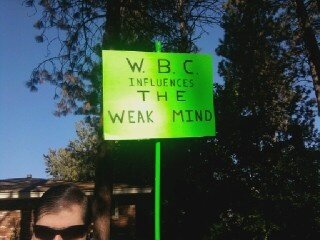
One major thing that makes people suck is bigotry. Hatred toward people forwbc some arbitrary thing, like skin color, country of origin or even sexual preference. Some of the current, most famous bigots that we encounter in the news, today, is the Westboro Baptist Church. Fred Phelps an his family have made hatred a way of life. If you’re not aware of who WBC is, please see here (yes, it is wiki, but the reference, in this case, is justified).

On October 21st, I got to see that hatred, but I also got to see how it can be dealt with. I got to see hate and anti-hate on that day. The following is an account of what happened.

I found out that Westboro Baptist was to visit our area right around the beginning of October. This only gave us two and a half weeks to plan something. I started making plans that same day, what, exactly, I had to do, though, wasn’t entirely clear. I just knew that I needed people. I contacted people I knew, talked to people who ran local organizations and the whole putting something together thing became a big blur. I helped, I think, but I can’t really say how much help I was because so many others were working on it, too. In fact, within days there were planning meetings set up and we became pretty well organized from carpool planning to sign making.

On the day of the protest, we (myself and a few others I had helped plan with) had estimated there might be about 60 or so people counter protesting the WBC. We estimated this based on the groups we knew of getting involved. We didn’t think it would be a huge gathering, but we knew we’d have a bigger presence than WBC. That was important to us. We wanted to deflect their message. We wanted to simply make a bigger impact than they could.pirate-hat

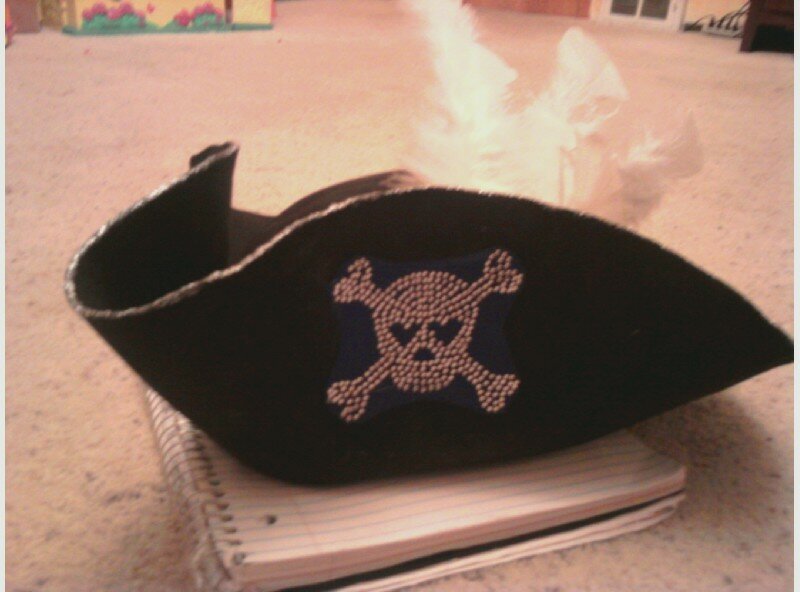
I started my day by walking from Gonzaga over to the Coffee Social, where I met up with some other counter-protesters, got some coffee and breakfast. I was dressed as a pirate. My short walk, as it turns out, taught me a little lesson in social hierarchies. Everyone gives pirates the right of way. I didn’t have to wait to cross any streets and I had people happily honk and wave as I walked by. The life of a pirate is good.

We left the coffee shop to head over to the nearby Gonzaga to find a few hundred people already crowding the sidewalk. It turns out, my acquaintances and I suck at estimating attendance for these things.

Example from a High School we were at later that day:

corner-school

At Gonzaga University, this happened:

gorilla1

and this:

band

and this:

lolcat-protest1

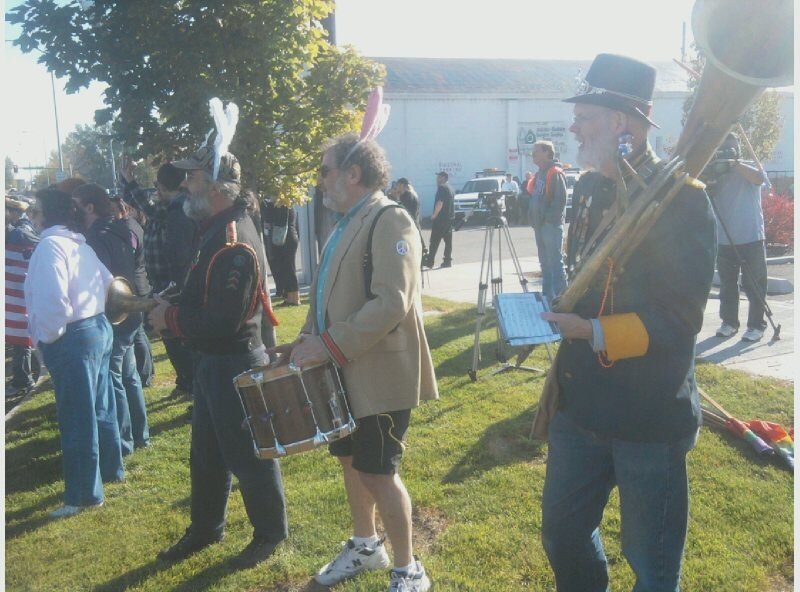
Gonzaga ended up being an impressive start to a great day. There was a band and a dancing gorilla (see above images), hundreds of people gathered and sang as they held up their signs. At one point, the whole crowd sang Lean On Me using song sheets that had been handed out, entitled, “Welcome to the Traveling Pride Festival!” Other songs included were, People in your Neighborhood and Gentle, Angry People.

The next stop in our journey was Moody Bible school. Moody is set in a small neighborhood, so it was tough to see how many were there. It was crowded and there were random trees. It was at Moody that I found counter-protest dog:

protest-dog

I also met this lady:

mastication

A Christine O’Donnell/Sarah Palin hybrid, she warned the crowd of the dangers of mastication and made sure that everyone knows that God hates bags.

Gridlocked by other counter-protesters, getting interviewed twice and posing for pictures with everyone who asked (pirates makes for great photo ops), led to me not really exploring the crowd at Moody very much, but it felt bigger than the crowd at Gonzaga. We were growing.

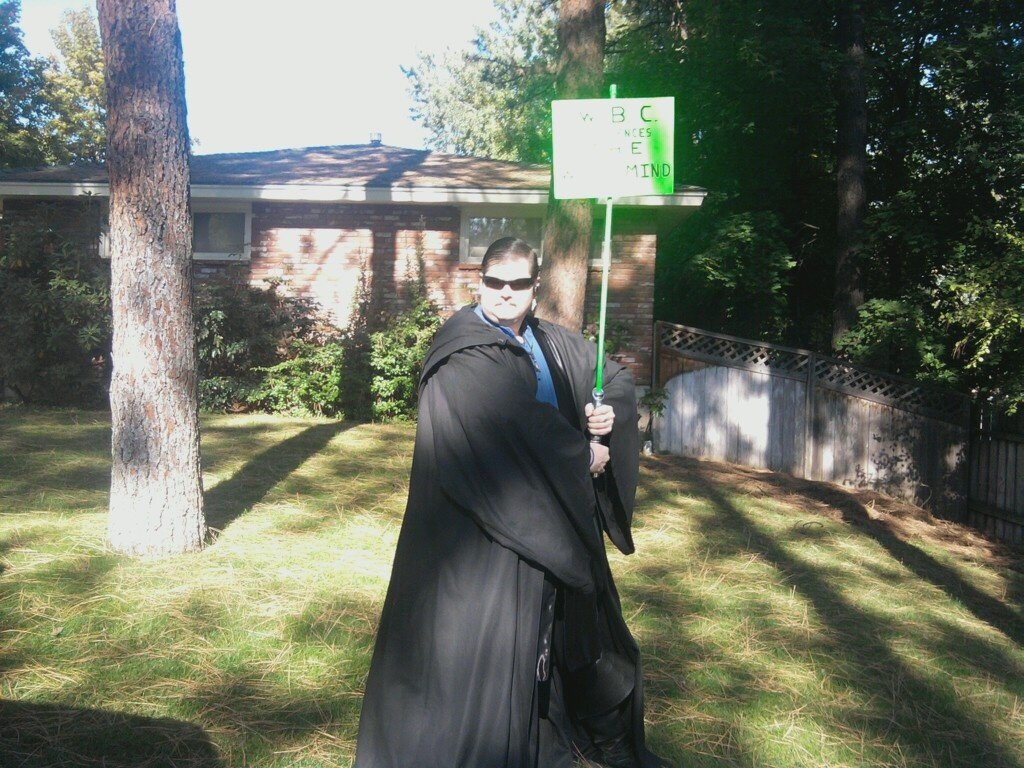
Visiting Whitwoth and Ferris is strangely blurred for me. I, again, had a lot of people stop me for photos. It was at one of those places that I met this guy:

use-the-force

weak-force

Light saber + anti-hate = I became an instant fan of his.

Another thing that happened is that, at some point, a group of people gave the WBC people little glasses of kool-aid. One of the people I was with had this sign:

koolaid

While I appreciate the morbid joke that is a reference to the People’s Temple when Jim Jones convinced his congregation to drink poisoned kool-aid, it made me uncomfortable. The last thing we need is more death because of dogma and even crazies like the Phelps clan don’t need to be martyrs to their own nonsense.

Another thing that made me uncomfortable was a moment when part of the crowd began chanting “go home” at the WBC. I, again, understood the sentiment, but the message was, itself, hate-filled, which doesn’t help matters when it comes to the message the WBC is already sending. Furthermore, I am a fan of problem-solving, not problem hiding. Sending the WBC home doesn’t solve the problem, it just moves it. We don’t want them in our communities, but we’re not helping if we push them off into other communities.

Eastern Washington University was the climax for the day:

crowdewuThe estimates I have heard claim that 1,000-1,200 people were at Eastern Washington University for the counter-protest. The crowd had seemingly grown, throughout the day, at each location and at EWU, it was at maximum. The sidewalks were full and security people walked up and down the streets to help remind us to stay on the sidewalk. One guy at EWU got arrested for causing a disturbance, he had been walking through the crowd, telling people they were sinners and going to hell. There was music and activities at EWU, but I chose to go to the synagogue instead of staying with the festivities.

At the Synagogue, the Rabbi had asked that counter-protesters not stay outside, and requested that they come inside for a meeting of peace. I was more than happy to accept that proposal, as I can at least understand why he preferred that approach. His belief is in not reinforcing confrontation and promoting peace by simply advocating it. There were some problems, though. One was, like the rest of us, he’d underestimated the size of the crowd. The synagogue is very small and could barely hold a few dozen, it certainly wasn’t big enough for a few hundred. We were a tad early, so we went to the synagogue, anyway. They had parked a bus and other vehicles in front of the building to block the WBC. Counter-protesters gathered at the street corners with their signs. Before entering the synagogue, we were asked to leave our signs outside. I was cool with that. Once inside, though, I learned that the meeting of peace was more of a Jewish presentation, and the conversation my friends and I had with the Rabbi was highly religious. Also, instead of sharing his perspective as his belief, he shared it as if it were absolute reality, which made my friends and I, who had various systems of belief and non belief, rather uncomfortable. We ended up leaving. Most of the people I was with chose to continue their counter-protest outside the synagogue. I still felt it was important to respect the wishes of the Rabbi and not protest outside his synagogue, so I walked to a nearby store and called for a ride home.

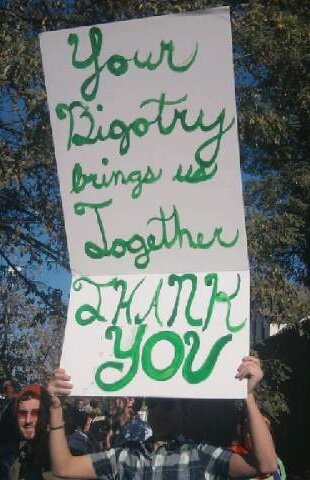
Here are some other pics from the counter protest:

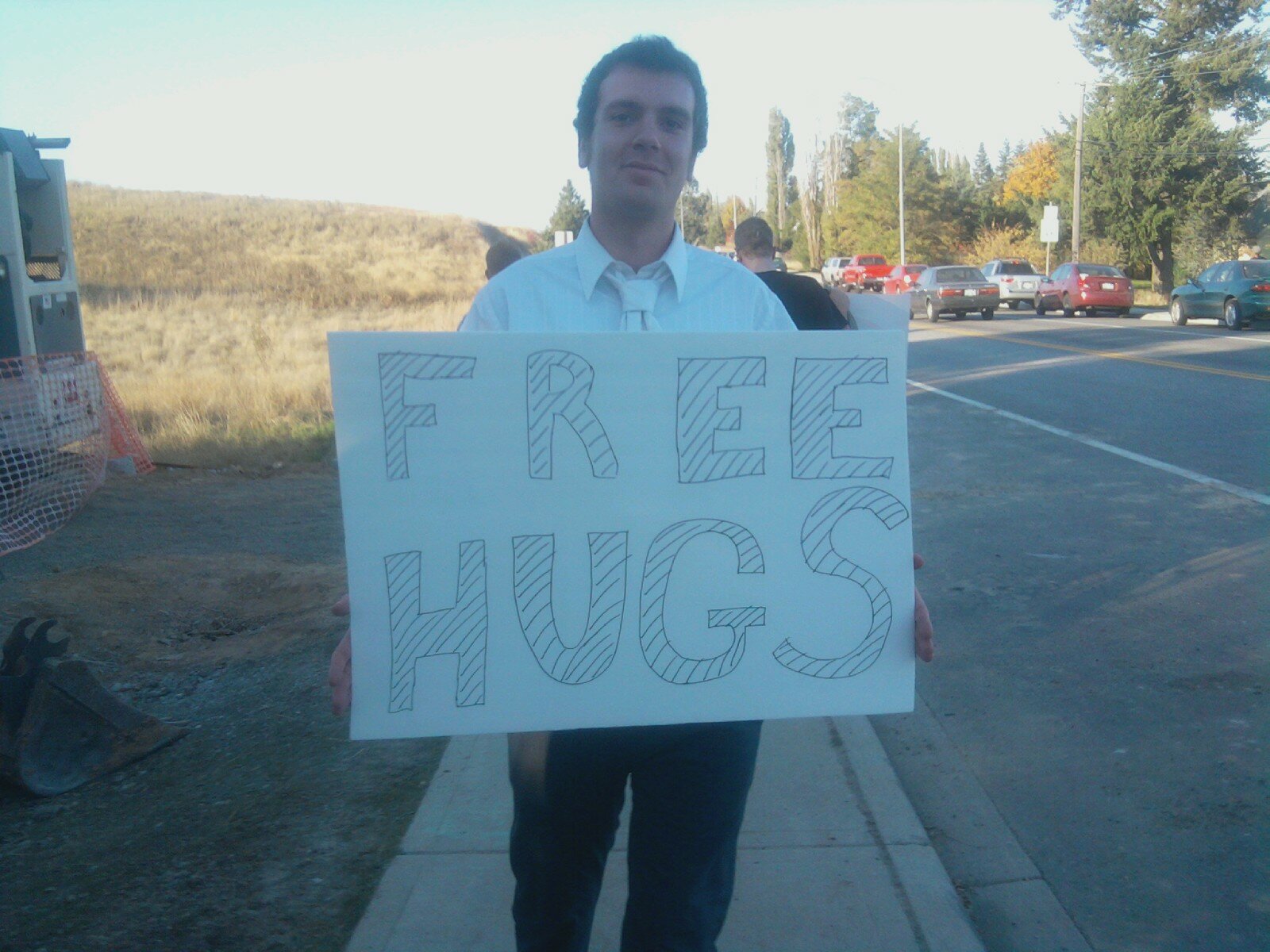
bring-together

crowd

dyke

eradicate-shame

fsm

gay-fine-byme-shirt

spreadlove

I wish I could have gotten more pictures of signs, but after Gonzaga, it was just impossible to navigate the crowd.

Overall, the day was made of win. We were able to make our own messages of peace and acceptance much louder than the WBC could ever be. Along with all I mentioned above, a few other things are worthy of note. Firstly, there were multiple fund raisers going on, some of them a bit, … uhm … not congruent with what we were legally allowed due to lack of time to get permits. The Inland Northwest LGBT center did a lot to help keep people organized alongside several other groups that I didn’t get the name of. Thomas Brown of the Spokane Secular Society started a fundraiser on facebook for various groups that raised $115. Postcards from Equal Rights Washington were handed out to help send a message to our legislators in favor of equal marriage rights. Members of a Patriotic Motorcycle Club, which I didn’t get the name of because everyone had a different answer and when the cyclists walked by me, I got flirty with one’s daughter (*blush*), also showed up and made lots of noise and showed off their patriotism.

© 2012 Sex and Science Suffusion theme by Sayontan Sinha